

When the Chancellor delivered the Budget on 28 October 2026, many called it a mini budget. Look past the headlines, though, and there is a lot in it that will shape how deals, business sales, restructures and employee share schemes are planned over the next 18 months.
On 4 November 2026, Sarah Gardner and Kate Reynolds of Allegro Tax ran a special edition of our Tax Insights Live webinar series named Autumn Budget 2026: A Corporate Lawyers’ Briefing (full recording at the end of this article). This article pulls together what they covered, in plain English.
You do not need to be a tax specialist to follow it. It is written for corporate lawyers, and is just as relevant to accountants advising owner-managed and private equity-backed businesses. Our aim is to help you spot when a client might be affected, so you know when to ask the question.
The big message: timing is everything! The changes start on different dates, some are not yet law, and each one is triggered by a different event. On a live deal, getting that sequencing right is where you add real value.
The timetable for change
A Budget speech announces plans. It does not change the law on the day. Sarah grouped this year’s measures into three buckets:
- Already in force: a handful of changes took effect on 28 or 29 October 2026, the day of the Budget or the day after.
- Draft law published: the wording exists, but may still be tweaked before Parliament passes it.
- Still being consulted on: the government is asking for views, so the final rules could look quite different.
Most changes will become law through the next Finance Bill (the annual Act that puts Budget tax changes into law), Finance Bill 2026-27.
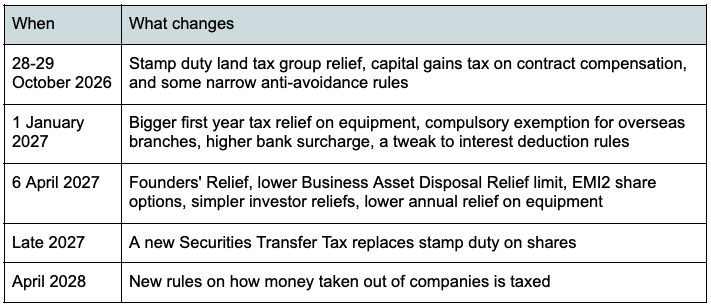
Why the start date is not the whole story
Each rule is switched on by a different event, and it is rarely the completion date of a deal. So two clients doing similar deals on the same day could be treated differently.
- Stamp duty land tax: the “effective date”, usually when the purchase completes or the buyer takes possession.
- Compensation for lost contract rights: the date the money is received.
- Capital allowances (tax relief on equipment): the date the money is spent.
- Founders’ Relief: the date of sale, and how long the founder held the shares before it.
- Capital gains tax generally: usually the date the contract becomes unconditional, which can be weeks before completion.
On any live matter, check which trigger applies before telling a client a change will or will not affect them.
Already in force: changes from Budget day
Stamp duty land tax group relief: a gap is closed
The background: when one company in a group transfers property to another, it can usually avoid stamp duty land tax (SDLT) by claiming group relief. The catch is that the relief is taken back (“clawed back”) if the company that received the property leaves the group within three years while still owning it.
What has changed: until now, winding up the company that sold the property could stop that clawback from working. The Budget closes this gap for transactions with an effective date on or after 29 October 2026. Deals under contracts signed before that date are protected, subject to conditions.
What it means in practice: property is often moved around a group to tidy things up before a sale, or afterwards. If group relief was claimed and the plan involves dissolving the transferring company, check whether a stamp duty bill could now come back.
Capital gains tax on compensation for lost contract rights
The background: capital gains tax (CGT) already applied to lump sums received for giving up or surrendering rights.
What has changed: after a tax tribunal case, the rules have been widened. CGT now also catches a lump sum paid under a contract as compensation for losing rights under that same contract. This applies to sums received after 28 October 2026.
What it means in practice: think about break fees, termination payments and similar compensation built into deal documents. Do not assume a payment escapes CGT just because the contract itself provides for it. (Whether a payment is treated as income or capital is a separate question, but where it is capital, this change matters.)
Other narrow changes
Three more targeted rules took effect straight away. Most advisers will not meet them, but they are worth knowing about:
- Anti-avoidance rules on “sale and leaseback” of equipment now cover a wider range of leases.
- Anti-avoidance rules for cell companies (structures used mainly in insurance and investment funds) are being extended.
- The tax rules on interest paid on Scottish Government bonds are changing.
Legal privilege: HMRC sets out its position
This is not strictly a Budget measure, but it matters to lawyers and accountants alike. On 23 October 2026, HMRC published its view on how legal professional privilege (the rule that protects confidential legal advice from disclosure) fits with its powers to demand documents in avoidance cases.
There is nothing new in it, but it gathers court decisions and earlier guidance in one place. It focuses on three regimes that can hit advisers, not just clients, with significant penalties:
- DOTAS: the disclosure of tax avoidance schemes rules, which require certain schemes to be reported to HMRC.
- POTAS: the rules for promoters of tax avoidance schemes.
- Enablers: penalties for anyone who helps design or deliver avoidance arrangements that fail.
What to take from it:
- Without privilege, HMRC’s powers to demand documents are very wide. Kate recalled HMRC once asking to see every piece of correspondence between adviser and client, embarrassing emails included. Write every email and WhatsApp message as if HMRC might read it.
- The guidance gives examples of advisers HMRC thinks have, and have not, acted properly.
- You cannot have it both ways. If a client wants to rely on legal advice to reduce a penalty, they cannot also keep that advice secret under privilege.
- It explains how HMRC will handle disputes over whether a document really is privileged.
From 1 January 2027: small print that moves deal value
These can look like technical points for the tax team. Each one, though, changes how much tax a business pays and when. That flows straight into what a buyer will pay for it.
Capital allowances: one up, one down
The background: businesses cannot deduct the full cost of equipment, machinery or vehicles from their profits in the year they buy them. Instead they claim capital allowances, tax relief spread over time. A “first year allowance” gives a bigger chunk of relief upfront. A “writing down allowance” gives a smaller percentage each year after that.
What has changed:
- The first year allowance for most equipment rises from 40% to 50% for spending from 1 January 2027. This mainly helps businesses that cannot already use “full expensing” (100% relief upfront, available to most companies).
- The main annual writing down allowance falls from 14% to 12% from April 2027.
Why it matters on a deal: a private equity buyer of a manufacturing business may be planning heavy investment in new kit, and counting on the tax relief that comes with it. Less relief means more tax and less cash, which can change the valuation and even the price. It may also reopen questions about buying the business’s assets rather than its shares, and about when to time the spending. Lawyers do not need to run the numbers, but should spot when allowances are a big part of the deal.
Overseas branches: the exemption becomes compulsory
The background: a UK company can trade abroad through a local subsidiary company, or through a branch (in tax terms, a “permanent establishment”), which is simply part of the UK company operating overseas. Until now, UK companies could choose whether to exempt their foreign branch profits from UK tax.
What has changed: for accounting periods starting on or after 1 January 2027, the exemption is compulsory. Branch profits will be exempt from UK tax, but branch losses can no longer be used to reduce UK tax either.
Why it matters on a deal: a UK buyer acquiring a group with large overseas branches needs to understand how much tax the group will pay going forward. It may also affect whether new overseas expansion is set up as a branch or a subsidiary.
Bank surcharge doubles, for now
Banks pay an extra corporation tax charge on top of the normal rate. This surcharge rises from 3% to 6% for 15 months. It only matters for deals involving banks, but there the higher tax bill feeds directly into profits, valuation and possibly price.
Interest deductions: a creative sector tweak
The background: the corporate interest restriction limits how much interest a large group can deduct for tax, broadly to a share of its earnings (a tax version of EBITDA). Heavily borrowed groups feel this most.
What has changed: from 1 January 2027, tax credits for film, TV and video games production will no longer count towards those earnings. So a private equity-backed film or games group with significant debt may be able to deduct less interest, and will pay more tax. It is a narrow change, but for those groups the financial model needs revisiting.
From 6 April 2027: selling a business and rewarding staff
Founders’ Relief: great headline, tough to get
What it is: a new relief meant to cut the capital gains tax founders pay when they sell the business they built.
The reality: the conditions are so strict that one commentator has nicknamed it “Schrödinger’s tax relief”: it exists and does not exist at the same time, because almost nobody can qualify.
Sarah and Kate could not think of a single deal they had advised on in the last year or two that would have qualified, even though many were excellent businesses with strong exits. As Sarah put it, it looks designed for unicorns, and there are not many of those. HMRC is still consulting on the conditions, so they may yet be relaxed. The draft mentions a five-year qualifying period, so anyone who might qualify should start planning early.
Business Asset Disposal Relief: the lifetime limit halves
What it is: Business Asset Disposal Relief (BADR, previously Entrepreneurs’ Relief) lets business owners pay a lower 18% rate of CGT on gains from selling their business, rather than the standard 24%. There is a lifetime cap on the gains that qualify.
What has changed: to help pay for Founders’ Relief, that cap falls from £1 million to £500,000 for sales on or after 6 April 2027. For someone who would have used the full £1 million, the extra tax is around £30,000.
What to expect: a rush of business owners trying to complete their sale before 5 April 2027. Talk to affected clients now. Remember that for CGT the date of sale is usually when the contract becomes unconditional, not when the deal completes.
CSOP is renamed EMI2, and gets more generous
The background: share options give employees the right to buy shares later at today’s price, so they share in the company’s growth. Two government-backed schemes give these options favourable tax treatment:
- Enterprise Management Incentives (EMI): the best-known scheme, for smaller, growing companies.
- The Company Share Option Plan (CSOP): less well known, available to a wider range of companies. This is being rebranded EMI2, largely because everybody understands EMI and few people understand CSOP.
What has changed:
- The EMI2 limit per employee doubles from £60,000 to £120,000 of shares under option.
- Options can be exercised (turned into shares) for up to 15 years.
- Companies that qualify can use EMI and EMI2 together, allowing up to £370,000 of shares under option per employee.
- EMI gets a 180-day window to exercise options after a “disqualifying event”. For example, if the company is taken over or a new holding company is put on top, options can stop qualifying. Employees will now have six months to act rather than losing the tax benefit.
What to do: this is a good time to review clients’ existing share option plans. A company already using EMI may now be able to add EMI2 and give key people a bigger stake.
EIS, SEIS and VCT: some welcome simplification
The background: the Enterprise Investment Scheme (EIS), Seed Enterprise Investment Scheme (SEIS) and Venture Capital Trusts (VCTs) give investors generous tax relief for backing young, higher-risk companies. The idea is simple. The rules are not, and mistakes are common.
What has changed:
- SEIS, EIS and VCT investments can be made on the same day. At present, SEIS shares must be issued at least a day before EIS shares.
- If someone invests more than the limits allow, relief will still be available on the part within the limits, rather than risking the whole amount.
- One investor paying late should no longer jeopardise relief for everyone else in the round.
Late 2027: a new tax on share transfers
The background: today, buying UK shares usually means paying 0.5% stamp duty or stamp duty reserve tax. Stamp duty is the old paper-based version, charged on a signed transfer form. Stamp duty reserve tax (SDRT) covers electronic and other paperless transfers. Having two parallel taxes adds paperwork.
What is changing: both will be replaced by a single, digital Securities Transfer Tax, which is self-assessed (worked out and reported by the taxpayer, rather than documents being sent to HMRC for stamping). There is no confirmed start date yet. The 0.5% rate is expected to stay, so this is about modernising the system rather than raising more money.
Points from the draft law:
- Tax is due when the agreement to buy is made, as with SDRT today, rather than when a transfer form is signed.
- Relief for transfers within a group of companies stays, but with its own definition of a group.
- The charge on paper documents disappears.
- The definition of which shares are taxed is being updated.
What it means in practice: the cost of most deals should not change, but the completion process will. Expect new steps for dealing with the tax at completion, especially for private share sales. Watch the transitional rules for deals that straddle the start date, and how group relief and reconstruction relief will be claimed.
April 2028: how money taken out of companies is taxed
The big picture: individuals pay much less tax on capital gains than on income. Over the years, some advisers have come up with schemes to make what is really income look like capital, so it is taxed at the lower rate. The government is happy for genuine commercial transactions to be taxed as capital. It wants to shut down the rest.
Earlier in 2026 it consulted on seven proposals in one document, Modernising the Taxation of Distributions and Repayments of Capital from Companies. (A “distribution” is any payment of company money to shareholders, a dividend being the obvious example.) Detailed consultation continues through 2027, with draft law promised during the year. The changes will apply from April 2028, and only going forward, not backdated.
Capital reductions and demergers
The background: a company can reduce its share capital and hand money or assets back to shareholders. This is often how a business is split in two, known as a demerger. For example, a client may want to separate a trading business from a property or investment business so the trading side can be sold. There is a separate “statutory demerger” route with its own tax reliefs, but its conditions are so restrictive that the capital reduction route is often the only practical option.
What is changing: payments made on a capital reduction will be taxed as a dividend (income) to the extent they exceed what shareholders originally paid for their shares. That is often only a tiny amount, so most of the payment could be taxed as income.
Many respondents argued for capital reductions to be left alone. The government’s answer is instead to make the statutory demerger easier to use:
- It will look at removing the “areas of friction” that put companies off.
- It recognises that businesses are often split up ahead of selling one part.
- It plans to let a demerger ahead of a sale qualify in some cases, such as selling a division of a trading group to a third party.
As Sarah said, capital reduction demergers are used constantly in practice. How this is resolved will matter a great deal. See HMRC’s guidance on distributions, including demergers.
Payments and loans from overseas companies
The government wants payments from overseas companies taxed the same way as similar payments from UK companies. The difficulty is that other countries’ company law does not always share UK ideas of what counts as share capital or a dividend. If the rules are not drafted carefully, they could catch genuine cross-border deals and make the UK less attractive to overseas businesses.
Loans, dividends and “unlawful” dividends
The background: a company can only pay a dividend out of accumulated profits. Most advisers have seen a client pay a dividend confidently, only to find months or years later that there were not enough profits. The dividend is then unlawful. The company law fix is one thing, but the tax position can be a mess: is the money now a loan to the shareholder, with its own tax charges?
What is changing: the government will clarify which set of rules takes priority. The same problem arises when a company buys back its own shares and the buyback later turns out to be invalid. Greater clarity here would be welcome.
Companies buying back their own shares
The background: when a company buys back its own shares from a shareholder, the payment can sometimes be taxed as a capital gain rather than as income, usually when a shareholder is genuinely leaving.
What is changing: this will stay available for genuine exits that benefit the company’s trade. But the government believes the rules are being used to extract cash while the shareholder stays involved, and will tighten them. Kate described a flyer suggesting retiring owners use a buyback to pass money to their children while keeping control: exactly the kind of arrangement HMRC is targeting.
The “transactions in securities” rules
The background: the transactions in securities (TiS) rules are an anti-avoidance backstop. They let HMRC tax as income a deal that was designed to turn income into capital.
What is changing: the rules will be made clearer, so they target avoidance without catching genuine commercial deals. Importantly, at present HMRC has to raise a tax bill if it thinks the rules apply. From 2028, taxpayers will have to decide for themselves whether the rules apply and report accordingly on their tax return.
What it means in practice: these changes touch preparing for a sale, group reorganisations, shareholders leaving a business and family succession. If a demerger or capital reduction is on the cards, consider whether it can be completed before April 2028.
Key takeaways: who to talk to, and when
- Clients planning to sell their business: check eligibility for reliefs early. BADR already requires shares to be held for two years, and Founders’ Relief may require five. Anyone close to a sale may benefit from completing before 6 April 2027.
- Clients with employee share options: review the option documents, and what would happen to them on a sale. Companies already using EMI may be able to offer more through EMI2.
- Clients restructuring or splitting a business: the best route may no longer be obvious, so bring the tax adviser in early. Where possible, consider completing demergers before April 2028.
- Buyers and investors: update financial models for the changes to capital allowances and interest deductions.
- Clients who have paid dividends without enough profits: watch for clearer rules on the tax treatment.
- Groups with overseas companies or branches: follow the detail and flag changes to affected clients.
- Every live deal: build these dates into the timetable, and think now about which clients you should be calling.
This was not quite the mini budget it first appeared. The restructuring and demerger measures in particular could have a real impact on clients over the next two years.
About the speakers
Sarah Gardner, Founder and Managing Director
Sarah is a Chartered Accountant and Chartered Tax Adviser who trained with a top 10 London firm. She has extensive experience working with businesses at every stage of growth, from start-up through scale-up to successful exit. This broad background lets her give strategic, practical advice to clients ranging from early-stage ventures to multinational enterprises.
Kate Reynolds, Associate Tax Director
Kate is a Chartered Accountant and Chartered Tax Adviser with over 20 years’ experience advising owner-managed and private equity-backed businesses. After training with a small accountancy firm, she spent 23 years with Deloitte and PwC, including 11 years as a Director. Kate advises businesses, shareholders, management teams and investors on complex tax matters, including M&A, international expansion, succession planning and equity incentives. She is known for her pragmatic, commercially focused approach.
Talk to Allegro Tax
Allegro Tax works alongside lawyers and accountants whose firms do not have an in-house tax department, but whose clients need specialist tax advice. If any of these measures could affect your clients, we are happy to have an initial, no-obligation conversation. Get in touch through our website or connect with Sarah and Kate on LinkedIn.
Useful links
- Budget 2026: GOV.UK hub
- Business Asset Disposal Relief
- Enterprise Management Incentives (EMI)
- Company Share Option Plan (EMI2)
- Enterprise Investment Scheme and Seed Enterprise Investment Scheme
- Capital allowances overview and writing down allowance rates
- Stamp duty land tax reliefs, including group relief
- Tax when you buy shares
- Disclosure of tax avoidance schemes (DOTAS)
- HMRC manuals: foreign branches, corporate interest restriction, distributions and demergers, purchase of own shares, transactions in securities
GOV.UK guidance pages may not yet reflect the Budget changes described above.
This article is a summary for general information only and does not constitute tax or legal advice. Several measures remain subject to consultation and may change before enactment.
Full recording