

It usually starts with a casual question at the end of a meeting. “While I’ve got you, what’s the tax position if we…?”
If you’re an accountant, it might be a client thinking about selling their company, bringing in an investor or giving a key employee shares. If you’re a lawyer, it might be a divorce settlement involving a second property, an estate with business assets, or a commercial lease that suddenly raises a VAT question.
Either way, you’re now holding a tax query that sits just outside your day-to-day expertise. You could probably work it out. But should you?
This guide is for accountancy and law firms that don’t have an in-house tax department. It gives you a simple, practical way to decide which tax questions to handle yourself and which to pass to a specialist, so you protect your client, your firm and your time.
Why this decision matters more than it looks
Tax rarely arrives labelled as tax. It’s tucked inside a share sale, a family settlement or a property transaction, which is exactly why it’s easy to underestimate.
Getting the call right matters for three reasons.
Your professional duties. Accountants who belong to the main professional bodies are bound by Professional Conduct in Relation to Taxation (PCRT) and their institute’s code of ethics, such as the ICAEW Code of Ethics, which expect you to work within your professional competence. Solicitors have a similar duty under the SRA Code of Conduct to provide a competent service. Knowing when to bring in help is part of meeting those standards, not a sign of falling short of them.
Your client’s outcome. Tax errors are often invisible until much later, when HMRC opens an enquiry or a missed relief can no longer be claimed. The cost of a wrong answer usually lands on the client, and the conversation about it lands on you.
Your time. Researching an unfamiliar area of tax can quietly eat a whole afternoon. That’s time you can’t bill comfortably and could have spent on the work your firm does best.
The four-question test
When a tax query lands on your desk, run it through these four questions. If the answer to all four points towards “handle it”, you’re likely on safe ground. If even one points towards “refer”, it’s worth a conversation with a specialist.
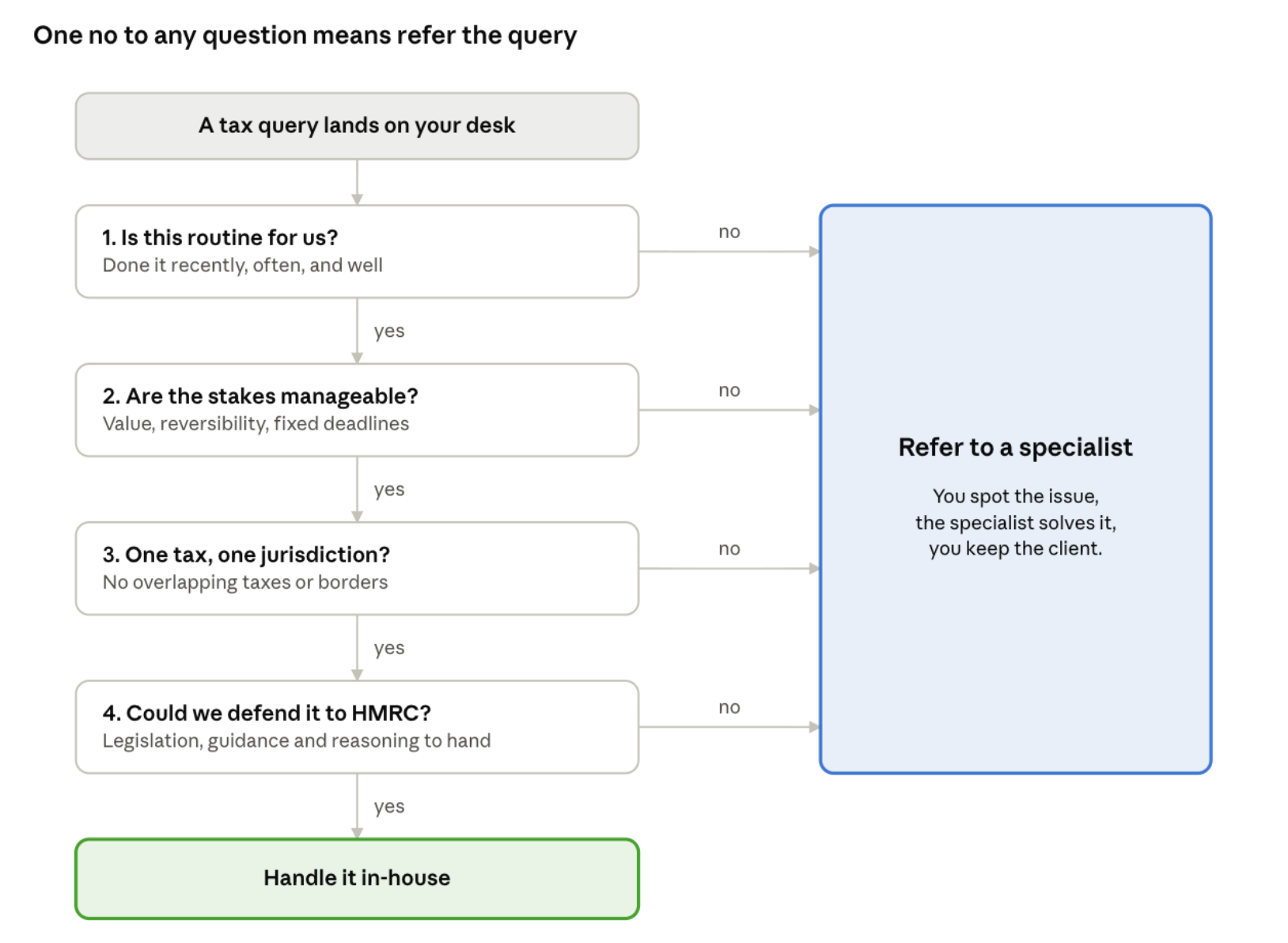
1. Is this routine for us?
Have you dealt with this exact issue recently, more than once, and with a good outcome? Familiarity is the best indicator of competence. A sole trader’s annual return is routine for most accountants. An employee share scheme or a demerger usually isn’t. For lawyers, a straightforward residential completion is familiar ground, while a transaction with a VAT option to tax on commercial property may not be.
2. What’s at stake if it goes wrong?
Consider the value involved, how reversible the decision is, and whether there are deadlines or elections that can’t be revisited. A £200 question about allowable expenses is very different from structuring a £2 million company sale, where a missed relief or a badly timed transaction can’t be undone.
3. Does it cross more than one tax, or more than one border?
Many of the most expensive mistakes happen where taxes overlap. A family business restructure can touch capital gains tax, inheritance tax, stamp duty and corporation tax at once. An overseas subsidiary brings in transfer pricing and permanent establishment risk. The more moving parts, the stronger the case for specialist input.
4. Could we confidently defend this to HMRC?
Imagine HMRC asks how you reached your conclusion. Could you point to the legislation, the guidance and your reasoning? If your honest answer is “I think so”, that’s useful information. Confidence that holds up under questioning is the standard to aim for.
And a quick fifth check: is this the best use of your time? Even if you could research it, the hours may be better spent on the work your clients come to you for.
Handle or refer? Common examples at a glance
Every firm is different, so treat this as a starting point rather than a rulebook. It reflects the queries accountants and lawyers most often bring to us.
| Area | Often fine to handle in-house | Usually worth a specialist |
|---|---|---|
| Company transactions | Routine dividend planning, simple share transfers between existing shareholders | Sales, mergers, demergers and group reorganisations (corporate tax) |
| Raising investment | Explaining the basics of SEIS and EIS to a client | Advance assurance applications and protecting investors’ relief (EIS and SEIS) |
| Rewarding employees | Standard payroll and benefits in kind | Designing EMI or other share schemes (employee share schemes) |
| Innovation | Spotting that a client might qualify for R&D relief | Preparing and defending the claim under current HMRC rules (R&D tax credits) |
| Property | Rental income and straightforward residential sales | Portfolio structuring, incorporating a property business, mixed-use or commercial deals (property tax) |
| VAT | Standard VAT returns and registration | Option to tax, partial exemption, land and property VAT (VAT) |
| Family and estates (lawyers) | Identifying that a divorce or estate has tax consequences | Capital gains on settlements, business property relief, valuations of shares (valuations) |
| Cross-border | Flagging that a client has overseas income or entities | Transfer pricing, permanent establishment and residence questions (international tax) |
Notice the pattern. In most cases, your role is to spot the issue. The specialist’s role is to solve it. That split keeps you in control of the client relationship while making sure the technical detail is right.
“The best advisers I know aren’t the ones who try to answer everything. They’re the ones who know exactly where their expertise ends and who to call when a question goes beyond it. Referring a tax query isn’t handing your client away. It’s making sure they get the right answer, while you continue to be the person they trust.”
Sarah Gardner, Founder and CEO, Allegro Tax
How to refer well: what to send a specialist
A good referral saves everyone time and keeps costs down for your client. Before you pick up the phone, try to gather the following:
- The question in one or two sentences. What does the client want to achieve, not just what they’ve asked?
- The key facts and figures. Values, dates, ownership structure and anything already agreed.
- The deadline. Completion dates, filing deadlines or a board meeting the advice needs to be ready for.
- What you’ve already looked at. Even rough notes help a specialist avoid covering the same ground.
- How you want to work together. Some firms want a written report for the client. Others prefer advice addressed to them, which they pass on in their own name.
That last point matters. A good specialist adviser should work as an extension of your team, fitting around your relationship with the client rather than replacing it. If you’d like to see how that works in practice, our 7-step project delivery framework explains each stage and we’d be happy to show it to you in a chat.
The bottom line
You don’t need a tax department to give your clients excellent tax advice. You need a clear sense of where your expertise ends and a trusted specialist to call when a question goes beyond it.
If you’d like to keep building your own tax knowledge, our free monthly Tax Insights Live webinars are designed for accountants and lawyers, with CPD certificates for live attendees. And if a query has just landed on your desk and you’re not sure which side of the line it falls on, book a free call with our team. We’ll tell you honestly whether it’s something you can handle yourself.